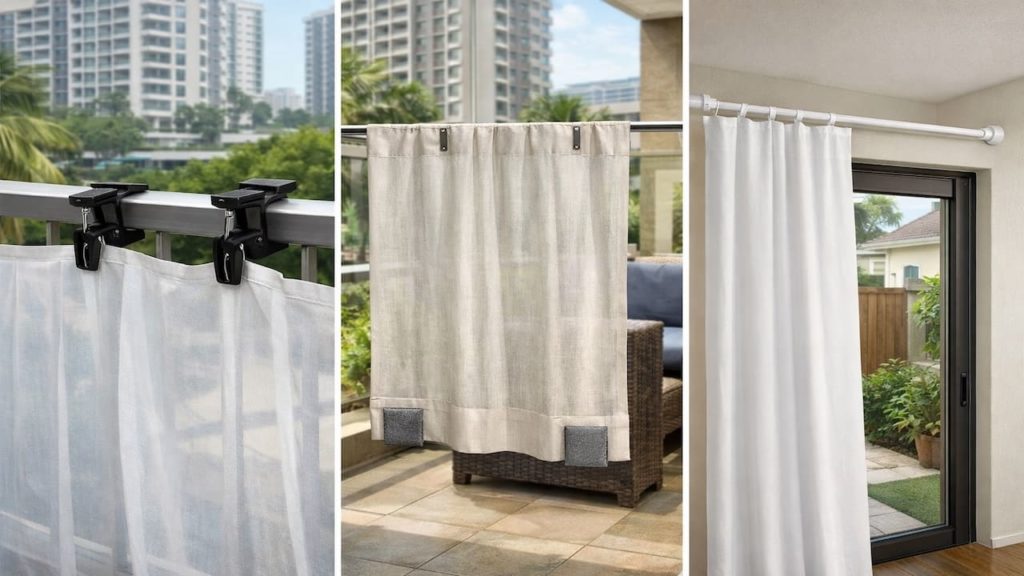
You want privacy without drilling, because you rent, you do not want damage, or your Malaysia condo balcony rules are strict.
But drill-free setups can slip, tip, or become noisy in wind and wet months if you rely on weak clamps or light bases.
In this guide, you’ll learn how to do drill free privacy safely using clamp, weight, and tension methods that fit Malaysia housing and humid weather.

Hi, I’m Ken. I write practical home guides for Malaysia—no fluff, just what works.
I hold a formal building design qualification and have spent about 20 years on job sites across hundreds of projects. My goal is simple: help you avoid costly mistakes with clear, safe steps—a quick way to decide what to do next.
1. Drill-free privacy setup: 5 tips
Safety comes from stability not from clever gadgets.
Malaysia rain and gusts turn screens into sails, and wet tiles reduce friction, so a “secure enough” setup can move when you least expect it. Wind reality. Drill-free privacy works when you limit height, spread the load, and choose anchor points that do not flex. If you keep it modular, you can also adjust sightlines without buying a full wall. Smart setup.
- Keep screen height low to reduce wind load
- Spread load across multiple contact points
- Check floor grip so bases cannot slide
- Test wobble with gentle top edge push
- Plan a clear walking lane beside screens
Some people trust one big clamp, but one clamp is one failure point, especially in Malaysia wet months. Redundancy wins. Use two or three supports and the whole system calms down. Stability first.
2. Clamp, weight, and tension methods safely
Combine methods so one weakness cannot cause a tip.
Clamps alone can loosen with vibration, weight alone can slide on wet tiles, and tension alone can slip if surfaces are smooth. Mix them. If you buy basic supplies like rubber pads, straps, and small brackets, RM5–20 can cover many starter parts, while the big improvement is placement and load spread. Cheap safety.
- Use rubber pads to increase clamp friction
- Add weight at base to lower center gravity
- Use tension straps to stop top sway
- Clamp onto rigid rails not thin decorative bars
- Place screens away from door swing zones
You may think heavier is always safer, but heavy loose objects become hazards in wind and kid traffic. Not worth it. Weight must be secured and low, not stacked like a tower. Calm and low is safer.
3. Why drill-free setups fail in wet heat
They fail from sliding more than from breaking.
Humidity and rain create a thin film on tiles and railings, lowering friction, so bases creep and clamps rotate over time. Slow drift. Once the screen shifts, it starts rubbing walls, scratching paint, and wobbling in gusts, which makes people over-tighten clamps and bend rails. Malaysia weather exposes weak friction fast.
- Check for creep marks on floor lines
- Look for clamp rotation on railing surfaces
- Inspect strap wear from sharp edges contact
- Notice rattling sounds during wind gusts
- Watch for algae slick film near base zones
Some blame the product, but many failures come from smooth surfaces and poor load spread, not the screen itself. Normal. Increase friction and reduce height and the same setup becomes stable. Fix the physics.
4. How to set up a stable drill-free privacy screen
Prototype first before you build the full run.
Set one panel, test it through a rain day, then copy the method across the rest, because small changes in railing shape alter clamp strength. Practical testing. cost is mostly time/effort, because careful trial beats buying extra panels you cannot secure. When the setup passes the push test and the storm test, lock the method and keep a monthly check routine.
- Start with one panel and test stability
- Use two clamps per panel for redundancy
- Add low base weight with secured tie points
- Run a strap to stop top edge sway
- Recheck after first storm and tighten gently
Some people install everything in one go, then discover one weak corner and the whole line becomes unstable. Avoid that pain. Test one. Then scale. Also keep airflow gaps so damp does not build behind the screen. Malaysia wet months punish sealed corners.
5. FAQs
Q1. Are clamp screens safe on condo balcony railings?
They can be safe if the railing is rigid and you use multiple clamps, rubber pads, and low height to reduce wind load. Test wobble after rain.
Q2. What is the safest drill-free method?
Clamp plus strap plus low weight is usually safest because it adds redundancy against slip and sway. Never rely on one clamp only.
Q3. Will tension rods work outdoors?
They can work in sheltered areas, but moisture and smooth surfaces can reduce grip over time. Use pads and secondary straps as backup.
Q4. How do I prevent sliding on wet tiles?
Use rubber feet, anti-slip mats, and distribute weight low and wide. Keep the base area clean so algae film does not form.
Q5. How often should I recheck the setup?
Recheck after the first storm, then monthly during rainy season. Malaysia humidity loosens friction-based systems faster than you expect.
Pro’s Tough Talk

Listen, I have over 20 years on site and I have done hundreds of different jobs, and drill-free privacy is fine, but only when you respect wind and wet tiles.
Cause is 3 things. You go too tall and it becomes a sail. You rely on one clamp and it slips. You put loose weight on the base and it slides like a soap bar in Malaysia rain film.
Do 3 steps now. Keep it low and modular, then clamp to rigid points with rubber pads. Add a strap to stop top sway and lock weight low with a tie so it cannot shift.
This is like balancing a broom on one finger, like taping a chair leg and praying—Redundancy is the real safety and the setup stops moving and starts behaving.
When the storm hits at night and when you rush past with laundry, you will hear the rattle if you did it wrong, tsukkomi: if you want that thrill, go camping instead.
Summary
Drill-free privacy works when you combine clamps, straps, and low secured weight so one failure cannot cause a tip. In Malaysia wet heat, friction drops, so keep height low and use rubber pads to prevent sliding.
If your setup creeps, rotates, or rattles after rain, reduce height, add redundancy, and improve floor grip before adding more panels. If your railing flexes, move the screen to a stronger anchor point or choose a lighter panel.
Do tip 2 today and then read your related guides on design privacy corners and child-safe privacy screens to keep the setup safe and comfortable.