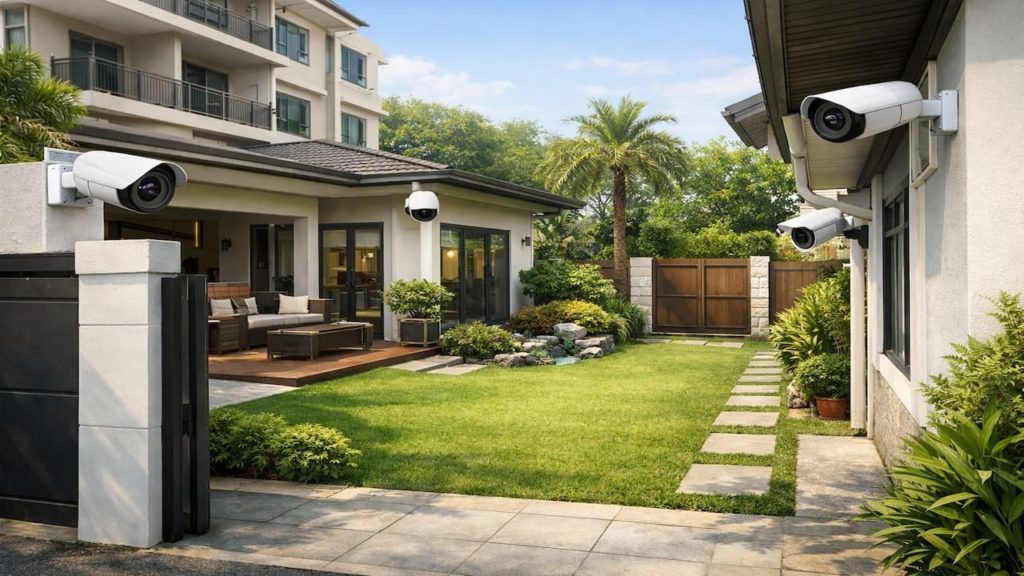
You want garden cameras that actually cover everything, but gates and side paths still end up with blind corners. In Malaysia, rain, glare, and humid nights make “good on paper” coverage fail in real use.
Walls, pillars, plants, and porch roofs create hidden angles, while wet surfaces reflect light and wash out detail. If you place cameras too low or too wide, you get a nice picture and still miss the moment you needed.
In this guide, you’ll learn how to pick camera spots that cover gates and side paths without leaving blind corners. You will also learn how to handle rainproof mounting, night visibility, and tidy cabling so the setup stays reliable.

Hi, I’m Ken. I write practical home guides for Malaysia—no fluff, just what works.
I hold a formal building design qualification and have spent about 20 years on job sites across hundreds of projects. My goal is simple: help you avoid costly mistakes with clear, safe steps—a quick way to decide what to do next.
1. Garden camera spots that cover all: 5 checks
Coverage comes from angles and overlap not from one camera.
Start with a simple map of your entry points and the paths people actually walk—coverage should follow feet. In Malaysia terrace homes and condo ground floors, corners happen at gates, bins, laundry zones, and side corridors. Put cameras where they can see faces and hands, not just a wide empty yard. Sightlines.
- Walk the perimeter and mark all sight blockers
- Stand at gate and trace approach paths
- Check side path corners behind pillars and meters
- Confirm camera can see faces not just backs
- Plan overlap so one view backs another
Some people chase a single wide view, but wide views often mean tiny details and missed angles. Reality. Two purposeful angles beat one “big” angle.
2. No blind corners at gates and side paths
Cover the gate and the turn because corners hide actions.
Gates need one camera for approach and one for the latch area—hands matter more than scenery. Side paths need coverage at the bend, not only at the start, because the bend is where bodies disappear. In Malaysia wet nights, reflections and dark plants can mask motion, so keep the view clean and consistent. Blind corners.
- Mount one camera facing gate approach line
- Mount second camera facing latch and handle zone
- Place a camera before the side path turn
- Place another after the turn for continuity
- Trim plants that block lenses and sensors
You might think one camera at the porch is enough, but porch views often miss the side path bend completely. Truth. If the turn is not covered, your “coverage” is a story you tell yourself.
3. Why cameras miss corners in Malaysia gardens
Obstructions and rain glare create false coverage in recordings.
Plants grow fast in Malaysia and quietly steal your view, and wet surfaces bounce IR or porch lighting back into the lens—night footage gets hazy. Roof edges drip onto lenses and cause foggy halos, while humidity can build condensation inside weak housings. Wide-angle lenses also stretch edges, so the corner detail becomes a blur. Physics.
- Watch night clips for glare and washed highlights
- Check for motion zones blocked by fence posts
- Inspect lens for rain streaks and condensation haze
- Review corners where fisheye distortion hides detail
- Notice plant growth changing the view each month
It is easy to blame the camera brand, but most “misses” come from placement, light, and maintenance conditions. Mechanism. Fix the environment and the same camera improves fast.
4. How to place cameras for clean footage and tidy cables
Mount higher and route cables safely so footage stays usable.
Choose mounting points that stay dry and stable, then aim to capture faces at entry height while keeping enough distance to reduce lens flare—small shifts matter. For weatherproof mounts, conduit, and sealing parts, RM30–250 is a common range depending on how many points you tidy up. Keep cables off the floor, add drip loops, and avoid routing where water runs along walls. Clean install.
- Mount cameras above head height for wider view
- Aim slightly downward to capture faces clearly
- Use drip loops before every cable entry
- Run cables in conduit along one neat route
- Test night view and adjust angles gradually
Some people hide cables quickly and regret it later when water finds the weakest joint. Reality. Route like a wet zone, then you stop fixing the same issue after every storm.
5. FAQs
Q1. How many cameras do I need for a small terrace home garden?
Many setups work with two to four cameras if you cover the gate approach, latch area, and side path turn. Overlap matters more than raw count when corners are the problem.
Q2. What is the best mounting height for outdoor cameras?
High enough to avoid tampering while still seeing faces is the goal. Aim slightly downward and test with a person walking the path to confirm you get usable detail.
Q3. Will plants and trees cause false motion alerts?
Yes, moving leaves and shadows can trigger alerts, especially in windy wet months. Trim the frame edges and avoid pointing directly at dense foliage.
Q4. How do I reduce glare and hazy night footage?
Avoid aiming into bright porch lights and reflective wet tiles, and keep lenses under small shelter edges if possible. Clean lenses regularly because humidity film builds quickly.
Q5. Should I point cameras toward my neighbor’s side?
Keep cameras focused on your own gate, path, and entrances for privacy and fewer disputes. Use masking zones if your system supports it so you avoid capturing unnecessary areas.
Pro’s Tough Talk

Look, I’ve got 20+ years on site and I’ve done hundreds of jobs, and “blind corners” are not mystery. A camera is like a guard dog with one eye, if you point it wrong it just stares at the fence.
Three causes. One, you mount one camera wide and call it done, then the side path turn becomes a magic disappearing trick. Two, you ignore rain glare and wet reflections, so night footage looks like a foggy aquarium. Three, cables and joints get sloppy, and water creeps in like termites in timber.
Do this in 3 steps. First, cover the gate with two angles, approach and latch, then cover the side path bend with continuity. Second, mount higher, aim down, and test with a real walk-through at night. Third, route cables with drip loops and sealed joints, then keep plants trimmed out of frame.
Don’t blame yourself, and don’t blame every installer either, but the structure is cold. People sell “wide angle” and forget overlap and corner geometry, because overlap is boring to market. Corners need redundancy not optimism.
Classic: the recording shows a shadow, and you still cannot tell who touched the gate. Classic: you install it once, then plants grow and your “coverage” quietly vanishes. Come on, want real coverage or a false sense of security?
Summary
To cover all garden entry risks, focus on gates and side path turns where corners hide movement. Use overlapping angles so one camera backs up the other.
If footage is hazy or corners vanish, fix glare, plant obstructions, and mounting height before buying more devices. Treat cabling and seals as part of the system in Malaysia wet months.
Walk your gate and side path tonight and mark the blind turn then follow with a warm lighting guide or power point safety guide to make the whole outdoor zone safer and easier to manage.