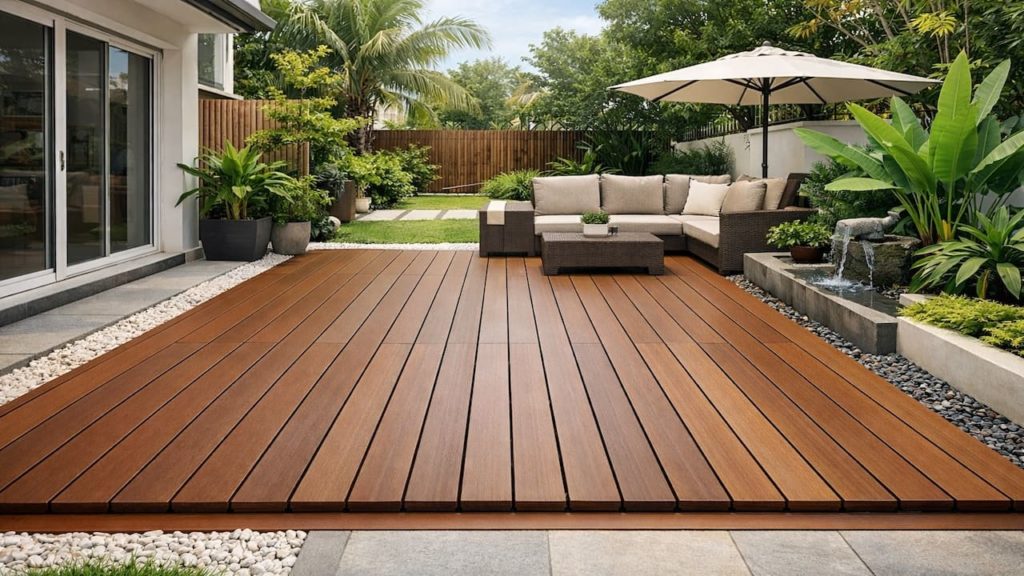
Your deck looked warm and classy at first, then the wet weeks arrived and you started noticing mildew, damp smell, and boards that never fully feel dry.
In Malaysia, humidity sits in shaded corners, sudden rain soaks surfaces fast, and terrace homes or condo patios often have tight airflow that traps moisture under decking.
In this guide, you’ll learn how to set decking gaps and drainage details so the surface dries faster while keeping the garden design tidy, safe, and easy to maintain.

Hi, I’m Ken. I write practical home guides for Malaysia—no fluff, just what works.
I hold a formal building design qualification and have spent about 20 years on job sites across hundreds of projects. My goal is simple: help you avoid costly mistakes with clear, safe steps—a quick way to decide what to do next.
1. Garden design with decking: 5 checks
Decking should be planned like a drying system not just a pretty platform.
Decks fail when water has nowhere to go, and Malaysia rain will test every weak detail within weeks. Shady spots near walls stay damp longer, so smell and mildew start there first. Small patios make it worse because airflow is limited. Dampness.
- Trace water paths from roof edge to deck
- Check airflow gaps along walls and planters
- Choose board direction that drains away fast
- Keep deck height clear from splash zones
- Plan easy access for under deck cleaning
Some people focus only on color and wood grain, because that is what you see. But what you do not see is the wet under-space — design that space, and the top stays fresher longer.
2. Drain gaps right to avoid mildew and smell
Correct board gaps stop water from lingering and that cuts mildew and odor.
Gaps let water drop through instead of sitting on the surface, but only if the gap stays open and consistent. In Malaysia, swelling from moisture can close tight gaps, then grime seals them like paste. Budget-wise, RM30–150 usually covers spacers, brush, and basic cleaner for a small tune-up. Simple control.
- Set board gaps using spacer blocks consistently
- Clear debris from gaps using a thin scraper
- Avoid tight gaps beside walls and posts
- Keep end joints staggered to reduce water traps
- Rinse gaps after storms to prevent sludge build
You might think smaller gaps look cleaner, so tighter is better. Tight looks neat until boards swell and the gaps vanish — keep the gap practical, and the clean look lasts with less smell.
3. Why decking gets mildew and smell in Malaysia gardens
Mildew starts when moisture and dirt stay trapped under low airflow zones.
Humidity feeds mildew, and warm shaded decks create a perfect incubator when dust and leaf bits collect. If water cannot drip through, it forms a thin wet film that never dries fully, especially near walls. RM15–60 can cover a mold cleaner and a stiff brush for targeted spots. Biofilm.
- Check for musty smell near deck edges
- Look for black dots in shaded board seams
- Inspect under deck for wet soil contact
- Find splash points near taps and hoses
- Notice where planters drip onto decking daily
People blame “bad wood” or “bad composite” right away, but the material is often fine. The real problem is moisture plus trapped dirt, then poor drying time — fix drying and cleanliness, and the smell stops returning.
4. How to set decking gaps and airflow for fast drying
Improve drying by combining gap consistency and ventilation around the whole deck.
Start with the perimeter, because a deck can have good gaps but still stay damp if the edges are boxed in. Leave vent space where the deck meets walls, and keep soil and mulch away from the under-space to prevent constant damp. If you need a small re-gap or edge vent adjustment by a handyman, RM200–900 is a common range depending on access and fixes. Airflow.
- Add ventilation slots along the deck perimeter
- Raise planters on feet to reduce dripping
- Redirect AC drip away from deck boards
- Keep under deck ground dry and clear
- Use stainless fasteners to prevent rust stains
It sounds like extra work, and you may worry it will change the look. The visual change is minimal, but the drying improvement is huge — make the airflow invisible, and the deck stays pleasant to stand on.
5. FAQs
Q1. What gap size is best for outdoor decking?
A consistent practical gap is better than chasing a perfect number, because boards move in moisture. Test after a heavy rain and ensure water drops through instead of pooling.
Q2. Is composite decking safer from mildew than wood?
Composite resists rot, but it can still grow surface mildew when dirt and moisture linger. Drying time and cleaning access matter more than the label.
Q3. How often should I clean decking in humid weather?
Clean lightly but regularly to stop biofilm especially after storms and leaf drop. A quick rinse and gap check usually beats deep scrubbing once a month.
Q4. Why does the smell seem stronger at night?
Night air is cooler and still, so damp odors do not disperse well. If airflow is trapped under the deck, the smell concentrates and feels worse.
Q5. When should I call a professional instead of DIY?
If boards are warped, gaps have closed everywhere, or the under-space stays wet for days, get help. Structural moisture problems often need re-leveling or ventilation changes.
Pro’s Tough Talk

Okay, I’ve been on site 20+ years and done hundreds of jobs, and deck stink always comes from the same lazy setup, not some mystery curse.
Cause one is gaps that are too tight, then they swell shut and water just sits there. Cause two is boxed-in edges, so the under-space has zero airflow and stays wet like a closed lunchbox. Cause three is dirt and leaves packing the seams, turning the deck into a sponge.
Do this now: first, clear every gap and edge with a thin scraper and rinse. Second, create airflow at the perimeter and stop soil touching the under-space. Third, redirect drip points from taps, planters, and AC lines away from boards.
If it smells musty, it is staying wet too long and no amount of “nice finish” fixes that. I’m not blaming you for trusting a quick install, and I’m not saying contractors are evil, but the structure is cold: trapped moisture always wins.
You know when you step out after a storm and the deck feels clammy under your feet, and when guests come over and you pretend you do not notice that damp smell at the corner, oi what is this, a spa for mildew or your garden.
Summary
Decking stays fresh when water drops through gaps and the under-space can breathe, which matters a lot in Malaysia humidity.
If mildew and smell keep returning, stop blaming the surface and check the edges, drip points, and under deck dampness, then adjust ventilation and cleaning access.
Fix one drip source and one airflow edge today then move readers to your drainage and wet-season garden checks for a full, repeat-proof setup.