If you searched “garden paths that dry quicker” you probably have a walkway that stays wet, looks dirty, or feels slippery after rain.
In Malaysia, sudden downpours, humid air, and shaded terrace-house side lanes can keep paths damp for hours. Puddles can come from slope, surface choice, clogged drains, or splash from roofs and planters.
In this guide, you’ll learn how to check slope and surfaces so your path dries faster and avoid puddles, stains, and that annoying wet-season slick feeling.

Hi, I’m Ken. I write practical home guides for Malaysia—no fluff, just what works.
I hold a formal building design qualification and have spent about 20 years on job sites across hundreds of projects. My goal is simple: help you avoid costly mistakes with clear, safe steps—a quick way to decide what to do next.
1. Garden paths that dry quicker: 5 checks
Fast-drying paths need water to exit quickly and predictably — not “soak in somewhere.”
In Malaysia rain, water arrives in bursts and then lingers because humidity slows evaporation. A path can look flat but still have tiny dips that trap water. Shade from walls and fences makes it worse. Wetness stays.
- Watch runoff direction during one heavy rain
- Mark puddle spots using chalk after rainfall
- Check tile joints for low dips and gaps
- Inspect drain covers for leaves and sediment
- Feel surface grip with wet shoes test
You might think it’s just “Malaysia weather so nothing dries.” True, humidity is real, but the same weather dries well-built paths fine, so use the checks and fix the trapping points first.
2. Avoid puddles by slope and surface choice
Slope plus surface texture decides whether water disappears or sits — simple physics.
A tiny slope is enough if the exit is clear, but a perfect slope is useless if the end point is blocked. In Malaysia terrace homes, roof drip lines can dump water onto one strip of the path and overwhelm it. Smooth glossy tiles also hold a thin film that stays slippery. Small choices matter.
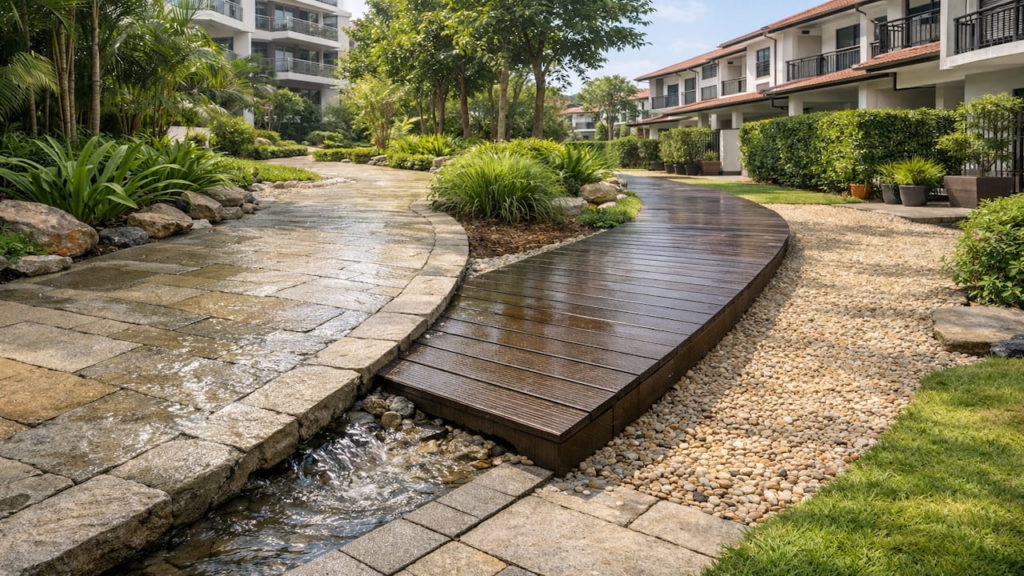
- Create a gentle fall toward a clear drain
- Choose textured pavers over glossy smooth tiles
- Add gravel strip where roof drip hits hardest
- Keep path edges open for fast runoff escape
- Align joints to avoid random low pockets
Some people say “just mop it dry.” That’s daily work forever, and it still won’t prevent algae film, so build the slope and pick a surface that releases water instead of hugging it.
3. Why garden paths stay wet in Malaysia conditions
Paths stay wet when shade and poor drainage slow drying — even if the surface looks clean.
Malaysia humidity means water does not evaporate fast, especially in narrow side yards with limited wind. When drains clog, dirty water backs up and leaves tide marks. When soil splashes onto the path, it feeds algae and makes the surface slick. Damp corner.
- Blocked wind corridors reduce drying after storms
- Clogged drains cause backflow and standing water
- Soil splash adds grime and algae feeding residue
- Flat sections hold films and slow evaporation
- Dark shaded edges grow slippery green buildup
You might blame the builder or the tile brand. Sometimes it is workmanship, but the repeat cause is water not having a clean exit, so focus on airflow and runoff routes before changing materials.
4. How to make a path dry quicker step by step
Fix the exit first then smooth the surface behavior — one change at a time.
Start with a drain cleanout, then correct the worst low spots, then add texture or a splash buffer; RM50–250 for basic gravel, patch mortar, and anti-slip strips is usually enough for a small Malaysia path. Do it before wet season peaks. Keep it simple. Test after the next storm.
- Clean drains and flush runoff with a hose
- Fill low dips using outdoor patch mortar
- Add anti slip strips on main stepping line
- Install gravel splash guard under roof drip
- Trim plants to open airflow along the path
You may think “I should redo the whole path.” Not always, because small targeted fixes often solve puddles without major work, and you can stop once drying improves and the walkway feels safe again.
5. FAQs
Q1. How much slope does a garden path need to avoid puddles?
A small consistent slope usually beats a perfect steep one. What matters is having one clear direction and a drain that stays open during storms.
Q2. Are textured tiles always safer in wet season?
Textured surfaces usually grip better when wet. Still, algae can make any surface slippery in Malaysia, so cleaning and drainage remain important.
Q3. Why do puddles form only in one spot?
That spot is often a tiny low dip or a joint that has settled. Mark it after rain, then patch the dip so water cannot pool there.
Q4. Should I add a gutter or a drip chain near the path?
If roof drip hits the walkway directly, redirecting it helps a lot. A controlled drip line reduces splash, stains, and slippery film buildup.
Q5. How often should I clean drains in rainy months?
Weekly quick checks work well because leaves and soil move fast in storms. Clearing early prevents backflow and dirty tide marks.
Pro’s Tough Talk

Alright, real talk. I’ve been on site for 20+ years, done hundreds of jobs, and “my path never dries” is usually a design fail, not bad luck. Malaysia wet season will punish lazy slope and lazy drain planning, and then somebody slips. Scary.
Three causes. First, the path is too flat, so water sits like a shallow bathtub. Second, drains are blocked or hidden, so runoff has nowhere to go. Third, the surface is too smooth, so it holds a slimy film like a wet sponge that never dries.
Do this now. Step 1: clear drains and hose-test the runoff direction. Step 2: patch the low dip spots and stop the pooling. Step 3: add texture and splash guards where water hits hardest, then open airflow by trimming plants.
This is the rule water must exit fast and the surface must release it. Aruaru #1: you repaint the wall and ignore the puddle, then the streaks return in one storm. Aruaru #2: you buy “nice tiles” and still slip because algae laughs at you. What is this, a walkway or an ice rink?
I’m not blaming you and I’m not saying every contractor is trash, but the structure is cold: if you don’t give water a route, it will make its own. Fix it now, or keep doing the wet-season shuffle like a clown.
Summary
Your path dries quicker when water has a clear exit, slope is consistent, and the surface does not trap a slick film.
If puddles keep coming back, re-check the exact low spot and the drain condition, then adjust the drip line or splash zone before you redo the whole walkway.
Do the 5 checks after the next rain and fix the exit path before you change the whole surface then read a drainage or anti-slip guide to keep Malaysia wet season safer.