Outdoor paving near trees looks great at first, then roots slowly lift edges, break straight lines, and open joints that fill with dirt after Malaysia rain.
Most failures happen because the design ignores root zones, water movement, and how trees respond when you block oxygen and moisture patterns.
In this guide, you’ll learn how to pave near trees without root lift using 5 checks that protect lines and joints in Malaysia terrace homes and condo gardens.

Hi, I’m Ken. I write practical home guides for Malaysia—no fluff, just what works.
I hold a formal building design qualification and have spent about 20 years on job sites across hundreds of projects. My goal is simple: help you avoid costly mistakes with clear, safe steps—a quick way to decide what to do next.
1. Outdoor paving around trees: 5 checks
Assume roots will reach the paving and plan the layout to tolerate movement.
Tree roots follow moisture and oxygen, and paving can change both, especially in Malaysia where soil stays warm and growth is active year-round. If you lock paving tight against a trunk, any expansion or surface root will push upward and crack the neat lines. A good plan is not “stop roots,” it is “avoid pressure points.” Root reality.
- Measure trunk size and estimate root zone spread
- Check for existing surface roots near the base
- Check where water pools and feeds root direction
- Check if paving will block air to soil
- Check if edges have room to move safely
You might think roots only grow deep. Many garden trees send shallow roots near the surface, especially when topsoil stays moist in Malaysia. Design for that, and your paving stays straighter. Simple truth.
2. Avoid root lift that breaks lines and joints
Keep a flexible buffer zone so the tree can move without lifting the hard surface.
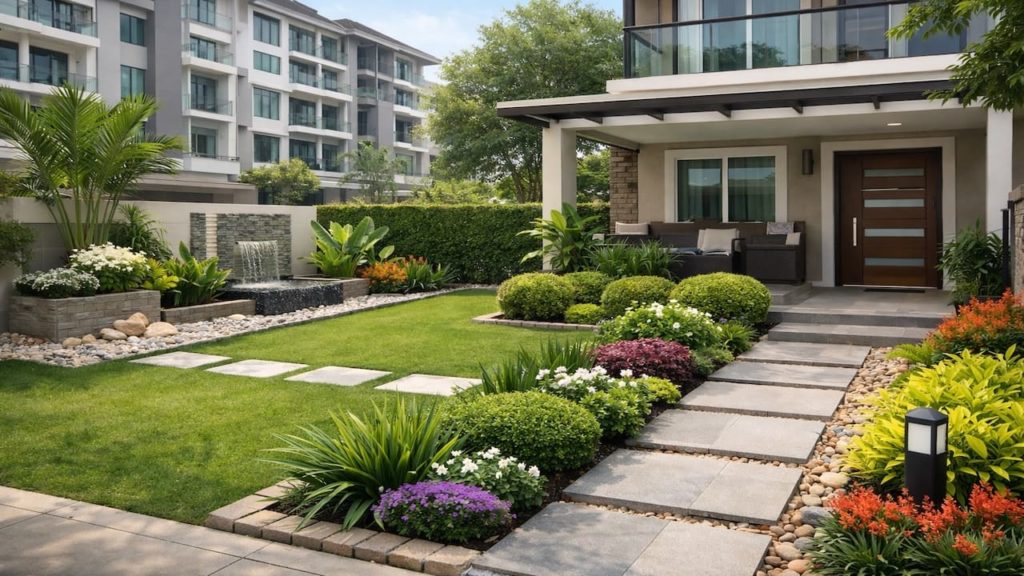
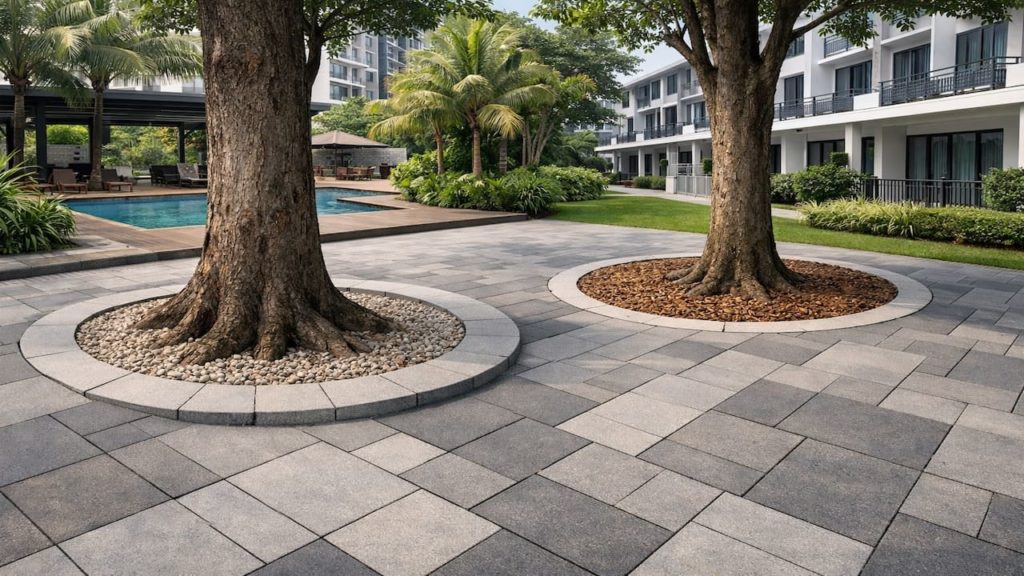
A small planting ring or gravel buffer around the trunk reduces direct pressure on paving. It also lets water enter the soil naturally, so roots do not hunt along the paved edge for moisture. In Malaysia rain, a buffer also prevents muddy soil from washing straight into your joints. This is mostly planning, and cost is mostly time/effort if you already have edging. Buffer ring.
- Leave a clear ring space around the trunk
- Use gravel or mulch inside the buffer zone
- Add edging to keep buffer material contained
- Avoid tight cuts that touch the trunk flare
- Keep joints tight near the tree to reduce dirt
Some people try to cut the pavers tighter to look “clean.” That usually becomes messy later because the tree grows and the cuts crack. A clean buffer ring looks intentional and stays easier to maintain. Longer life.
3. Why roots lift paving in Malaysia gardens
Roots chase water paths and paving often creates a perfect edge corridor.
When you pave close to a tree, you reduce oxygen and rain infiltration under the surface, then roots grow toward the nearest moist, airy edge. Downpipe runoff or hose watering near the trunk can intensify this direction. Malaysia’s steady warmth speeds growth, so small lifts become big line breaks over time. Slow push.
- Check watering habits that keep one edge moist
- Check downpipe discharge feeding the root side
- Check compacted soil that forces roots shallow
- Check tree species tendency for surface roots
- Check if paving traps water against the trunk
You may blame the tree, but the layout usually encouraged the root path. When you change water routes and leave breathing space, the pressure drops. The goal is coexistence, not a fight. Smart design.
4. How to pave near trees with less long-term movement
Use modular surfaces and stable edges so you can adjust without breaking everything.
Pavers are often easier than rigid tiles near trees because you can lift and reset sections if minor movement occurs. Build a strong base, keep drainage away from the trunk, and use edge restraint so lines stay clean even if you need future adjustments. If you need edging, geotextile, or extra gravel for a buffer ring, plan RM30–250 depending on size and access. Repair-friendly.
- Use pavers instead of large rigid slabs near trees
- Install geotextile to prevent soil migration into base
- Compact base well but avoid choking the root zone
- Keep runoff away from trunk flare and root collar
- Design a buffer ring that can be refreshed easily
You might think thicker concrete stops lift. It usually just cracks or heaves as one ugly piece, and repairs are harder. Modular paving plus a buffer ring is the practical approach for Malaysia gardens. Easier future.
5. FAQs
Q1. How close can I pave to a tree trunk?
Avoid paving tight to the trunk flare, and leave a buffer ring so the tree can grow. The larger the tree, the more space it needs to reduce root pressure.
Q2. Is it safe to cut roots to stop paving lift?
Cutting roots can harm the tree and reduce stability, especially for larger trees. It is better to redesign the paving with a buffer and flexible edges.
Q3. Are pavers better than tiles near trees?
Pavers are easier to reset if movement happens. Rigid tiles and slabs crack more visibly when roots or soil shift underneath.
Q4. What if my paving is already lifting near a tree?
Lift and reset the affected area, rebuild the base, and create a buffer ring so the paving is not pressed against roots. Also adjust watering and runoff routes.
Q5. How do I keep joints from filling with soil near trees?
Contain soil with edging, keep a buffer ring, and top up joint sand after storms. Prevent soil splash and leaf litter from settling into seams.
Pro’s Tough Talk

Listen. I’ve got 20+ years on site and I’ve handled hundreds of jobs, and trees do not “attack” paving, they just grow like trees.
The causes are three. People pave too tight to the trunk, they trap water and air so roots run to the edge, and they build rigid surfaces that cannot tolerate movement. Malaysia warmth keeps growth steady all year.
Do these 3 moves now. First, stop cutting pavers to kiss the trunk, leave a buffer ring. Second, fix runoff so you are not feeding roots along one edge every day. Third, use modular paving so you can lift and reset if the ground moves. You know the line that used to be straight and now looks wavy. You know the joint that keeps opening and catching your toe. Seriously, are you paving or wrestling a living plant?
I’m not blaming you, and I’m not saying every contractor is wrong, but the structure is cold: pressure points break lines and seams. Buffer zones prevent root lift so give the tree space and protect your paving.
Ignore it and watch your “straight” patio turn into a slow-motion roller coaster.
Summary
Prevent root lift by assuming roots will reach paving, leaving a flexible buffer ring, and avoiding tight cuts against the trunk.
If movement is already happening, reset modular sections and adjust runoff and watering so roots are not guided along the paved edge.
Give roots breathing space and your Malaysia paving lines stay clean longer. Next, read a base layer guide or an uneven paving fix guide.