You built raised beds to keep the garden tidy, but after rain the soil stays soggy and the wood starts to smell. In Malaysia, that wet cycle can turn a “simple bed” into a rot problem fast.
High humidity, sudden downpours, and compacted ground around terrace homes and condo patios slow drainage. If the base traps water, the bed stays wet even when the top layer looks dry.
In this guide, you’ll learn how to build a raised bed base that drains before rot starts and how to spot weak points early. You will also see why beds fail in humid weather, which layers matter most, and what to fix without rebuilding everything.

Hi, I’m Ken. I write practical home guides for Malaysia—no fluff, just what works.
I hold a formal building design qualification and have spent about 20 years on job sites across hundreds of projects. My goal is simple: help you avoid costly mistakes with clear, safe steps—a quick way to decide what to do next.
1. Garden raised beds that drain well: 5 steps
Start with the site not the soil because drainage begins under your feet.
In Malaysia’s wet season, placement decides how long your bed stays damp—bad locations create endless “small fixes” that drain time and money. Beds near downpipes, low spots, or shaded walls dry slowly and invite fungus. Choose a spot where runoff can escape and airflow can reach the boards. Good siting also makes daily watering easier.
- Mark a level spot away from downpipe splash
- Leave an airflow gap between bed and wall
- Set bed height above typical puddle line
- Plan paths so feet avoid muddy edges
- Angle corners away from roof drip lines
You might think soil quality is everything, but the same premium soil fails when it sits on a wet bowl. Foundation. Fix the location first, then the bed behaves like a garden tool, not a headache.
2. Build base before soil to prevent rot
A real base moves water down and out so wood does not stay soaked.
Clay and compacted fill under many Malaysian homes can act like a plate—water pools and lingers after every storm. When the bottom stays wet, roots suffocate and boards stay damp at the worst zone. Build a filter base so water passes through layers instead of pressing into timber. That is how you prevent the “mystery smell” problem.
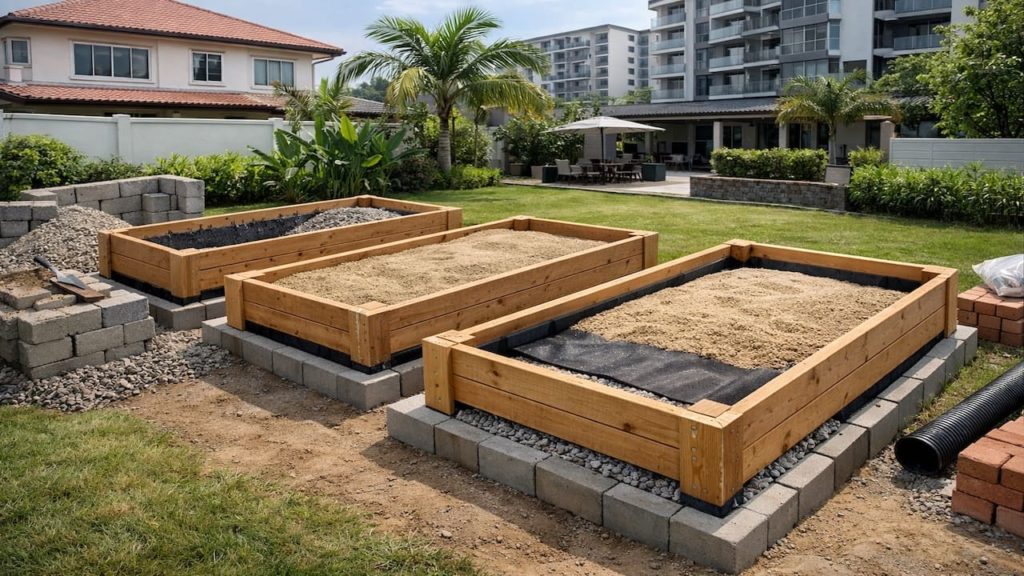
- Lay geotextile fabric to separate soil from clay
- Add crushed stone layer under the bed footprint
- Create an outlet path toward nearest drain point
- Cap with coarse sand for stable leveling
- Keep soil line below board top edge
Some people say “just add more soil,” but more soil on a bad base only stores more water. Reality. Build the base first, then fill, and rot becomes the rare exception.
3. Why raised beds rot fast in Malaysia wet weather
Rot is trapped moisture plus no airflow and it hides at corners.
Malaysia’s humidity slows drying, so shaded beds stay damp long after rain stops, especially beside fences and walls. Splashback from heavy showers keeps the lowest boards wet, and wet wood attracts termites and fungus. If the base sinks, the frame twists, gaps open, and water finds new pockets. The damage looks “sudden,” but the process is slow and steady.
- Smell sour soil after two days of rain
- Check corners where boards touch wet ground
- Spot termites drawn to damp shaded timber
- Watch moss forming where water never drains
- Notice soil sinking from base washout gaps
It is easy to blame the wood grade, but the bigger culprit is the drainage system you cannot see. Mechanism. Fix the water path and airflow, and even average boards last far longer.
4. How to build a draining base that protects soil and boards
Excavate firm then layer and slope so water has a clear exit.
Remove soft soil until you hit a firm layer, because a raised bed is only stable when the ground below is stable—no shortcuts. Add fabric and gravel so the base cannot turn into mud, then give water an outlet route. For many small beds, RM30–200 covers basic gravel, fabric, and simple hardware depending on size and choices. After that, the bed holds shape and dries faster.
- Dig to firm layer and compact base well
- Slope base slightly toward a drain exit
- Raise frame with feet to reduce ground contact
- Seal board end grain to slow water entry
- Mulch top layer to reduce rain splashback
People jump to rebuilding, but most beds improve with base work and a proper outlet. Practical fix. Do the base right, retest after a storm, and only replace boards that are already soft.
5. FAQs
Q1. Can I place a raised bed directly on clay soil?
You can, but it often becomes waterlogged after storms in Malaysia. Add a separation layer and gravel so the clay does not trap moisture under the frame.
Q2. What is the simplest base that still works?
Fabric plus gravel plus a clear outlet route is the reliable minimum for many home gardens. It prevents clay mixing, supports the frame, and lets water move away instead of sitting.
Q3. Do I need treated wood for outdoor raised beds?
Treated wood can help, but it is not a magic shield against standing water. If the base stays wet, even good boards rot faster than you expect.
Q4. How do I know if my bed drainage is poor?
If the soil smells sour, stays wet for days, or plants yellow after rain, drainage is likely weak—check the lowest corners first. Also watch for puddles around the outside edges.
Q5. How often should I inspect the base in rainy months?
Check after major storms and after weeks of daily rain, especially in shaded spots. Look for settling, washed-out gravel, and splash zones that keep boards wet.
Pro’s Tough Talk

Listen, I’ve been on site 20+ years and I’ve done hundreds of jobs, and raised beds fail in the same boring way every time. Malaysia rain doesn’t ask permission, and humidity keeps the damage alive like a slow leak.
Three causes. One, people build a pretty box and dump soil right on clay, like putting a sponge on a plate. Two, no exit path, so water becomes a silent thief and steals your boards from the bottom up. Three, splashback and shade keep corners wet, and rot throws a party.
Do this in 3 steps. First, dig down and make a firm base, no mush. Second, separate with fabric, add gravel, and give water an outlet route. Third, lift the frame slightly, keep soil below the top, and stop splash with mulch.
Don’t blame yourself, and don’t scream “all contractors are trash” either, but understand the structure they skip when budget gets tight. You don’t see the base, so it gets cut first. Base and outlet decide the lifespan and the rest is just decoration.
Aruaru: you buy premium soil, then it sinks after the first storm. Aruaru: you notice the smell only when guests come over. And you thought plants would solve drainage, seriously? Fix the base today, or keep donating wood to the rain.
Summary
Raised beds drain well when placement and base layers stop water from pooling under the frame. In Malaysia’s humidity, a trapped wet base leads to rot, smell, and weak plants.
If your bed stays wet for days after rain, check clay contact, missing gravel, and a missing outlet route. If the frame has twisted or sunk, rebuild the base before adding more soil.
Fix one bed base this week then move to a drainage-slope guide and a wet-season algae cleaning guide to keep the whole garden safer and cleaner. Small structural wins make every future planting easier.