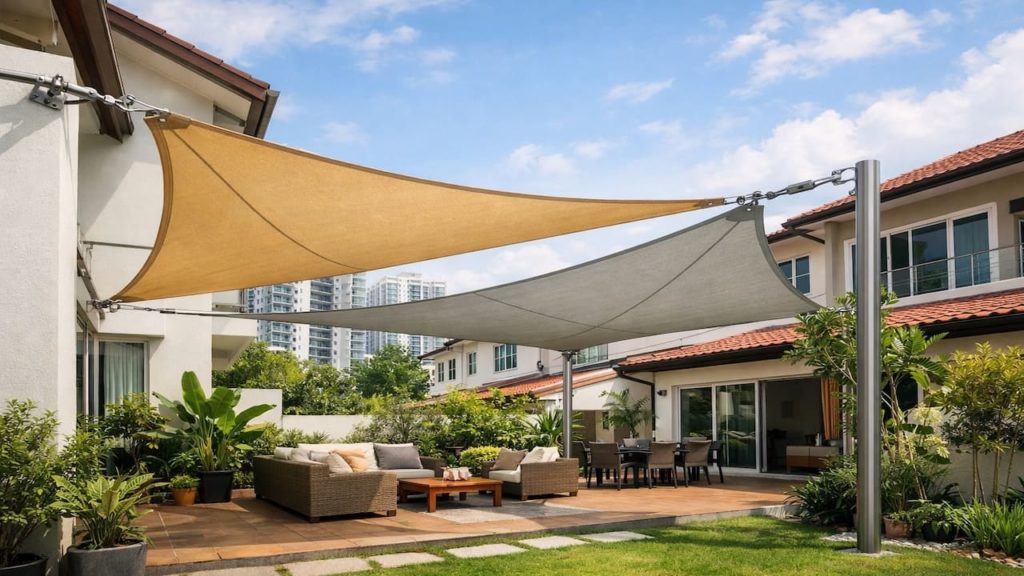
If you searched “garden shade sails done right” you probably want shade that looks clean and does not flap like crazy when the weather changes.
In Malaysia, hot sun makes you crave shade, but sudden storms and gusty rain can punish weak anchor points fast. Humidity also makes hardware rust and ropes stretch.
In this guide, you’ll learn how to install shade sails with strong anchors and proper tension so they stay stable, shed rain better, and last longer through wet season.

Hi, I’m Ken. I write practical home guides for Malaysia—no fluff, just what works.
I hold a formal building design qualification and have spent about 20 years on job sites across hundreds of projects. My goal is simple: help you avoid costly mistakes with clear, safe steps—a quick way to decide what to do next.
1. Garden shade sails done right: 5 tips
Shade sails work when the anchors are solid and the fabric stays tight — otherwise they become noisy and risky.
Malaysia weather is the real test: sun heats the fabric, rain adds weight, and wind pulls sideways like a sail on a boat. Stability first. Looks second.
- Choose anchor locations with real structural support
- Angle the sail so water drains in one direction
- Use hardware designed for outdoor corrosion resistance
- Set high tension so the fabric does not flap
- Leave clearance so edges never rub walls or trees
You might think any hook on a wall is fine. If the anchor is weak, the whole system fails, so treat anchors like the foundation of a small roof.
2. Anchor points and tension make it stable
Strong anchor points plus high tension prevent sag and snapping.
The goal is a taut surface that does not pump in the wind—Malaysia humidity and heat can slowly stretch ropes, so you need proper turnbuckles and solid mounts. Control. Quiet shade.
- Mount to concrete beams or steel posts not thin fascia
- Use turnbuckles to fine tune tension over time
- Keep each corner line as straight as possible
- Set one low corner to create a drainage slope
- Check anchors after storms and retighten as needed
You may worry tight tension will damage the wall. Wrong anchors damage walls, not tension, so use proper plates and spacing and the load spreads safely.
3. Why shade sails fail in Malaysia wet season
They fail when water pools and wind keeps shocking the anchors.
In heavy rain, pooled water turns the sail into a heavy bag, then wind shakes it, and the anchor points get hammered repeatedly. Malaysia storms are fast and loud. Fatigue happens.
- Low tension allows flapping and stress spikes
- Flat installs collect water and cause big sagging
- Weak walls crack around bolts under repeated load
- Rusty hardware seizes and snaps under tension
- Rope stretch reduces stability after hot sun days
You might blame the fabric quality only. Fabric matters, but most failures start at anchors and geometry, so fix slope and tension and the system behaves.
4. How to install a shade sail that stays safe
Plan slope first then choose anchors and tension hardware.
For Malaysia conditions, budget for proper plates and turnbuckles; RM120–600 for hardware and anchors is typical depending on size and mounting surfaces. Cheap insurance. You can upgrade hardware even if you keep the same sail fabric.
- Choose at least three strong anchor surfaces before buying
- Set one corner lower for controlled water runoff
- Use stainless turnbuckles and rated shackles
- Install backing plates to spread wall loads safely
- Retract or remove sails during severe storm warnings
You may think removing the sail is annoying. It is faster than repairing cracked walls and snapped hardware, and it keeps your family safe in sudden storms.
5. FAQs
Q1. What is the biggest mistake when installing shade sails?
Installing too flat without enough tension is the biggest mistake. Flat sails collect water and then the load jumps, especially during Malaysia downpours.
Q2. Do I need four corners anchored for a small area?
Not always, but every corner must be properly supported. Three-point sails can work well if anchors are strong and the slope is clear.
Q3. Can I anchor a sail to a plaster wall?
It depends on what is behind it. You need a structural beam or solid masonry, because wind loads can rip weak walls over time.
Q4. How do I stop flapping noise at night?
Increase tension and reduce slack in lines. Check rope stretch after hot days, because heat can relax materials and create flapping.
Q5. How do I maintain shade sails in humid weather?
Rinse dirt and dry the sail when possible. Check hardware for rust and retighten turnbuckles after storms to keep the system stable.
Pro’s Tough Talk

Ok, straight talk. I’ve been on site for 20+ years and done hundreds of jobs, and a shade sail that flaps is not “normal.” It’s installed wrong. Malaysia weather just exposes it faster.
Three causes. First, people anchor to weak spots like thin fascia or cheap brackets, then act shocked when it pulls out. Second, they install it flat, so rainwater sits like a bathtub. Third, they leave it loose, and wind shocks the anchors like punching a wall over and over.
Do this now. Step 1: find real anchor points, not decorative surfaces. Step 2: create a clear slope with one low corner. Step 3: tension it hard with turnbuckles and recheck after the first storm.
Here is the rule anchors plus tension equals stability. Aruaru #1: it looks fine in the afternoon, then wet season night comes and it drums like a broken umbrella. Aruaru #2: you ignore rust, then one day the shackle snaps. What are you doing, building a kite?
I’m not blaming you and I’m not saying every contractor is bad, but the structure is cold: weak anchors always fail when wind gets serious. Install it right, or enjoy your new outdoor percussion show, boss.
Summary
Shade sails stay stable when anchors are structural, tension is high, and the sail is angled to drain water quickly.
If your sail flaps or sags, fix slope and hardware first, then retension after heat and storms, because Malaysia weather changes load conditions fast.
Do the 5 tips today and treat anchors and tension as the real shade system then read a rainy-season maintenance guide to keep the setup safe and quiet.