A roof leak at the valley in Malaysia is common, because valleys collect the most water during wet season storms and the humidity keeps debris stuck. Quiet damage.
The tricky part is that the ceiling stain rarely sits under the valley itself, since water can travel along underlay, rafters, and wiring routes in terrace houses. Misleading.
In this guide, you’ll learn how to confirm a valley leak before it spreads by checking debris traps, overflow paths, and hidden seep lines that show up after heavy rain.

Hi, I’m Ken. I write practical home guides for Malaysia—no fluff, just what works.
I hold a formal building design qualification and have spent about 20 years on job sites across hundreds of projects. My goal is simple: help you avoid costly mistakes with clear, safe steps—a quick way to decide what to do next.
1. Roof leak at valley: 5 checks
Valley leaks usually start with trapped water not broken tiles.
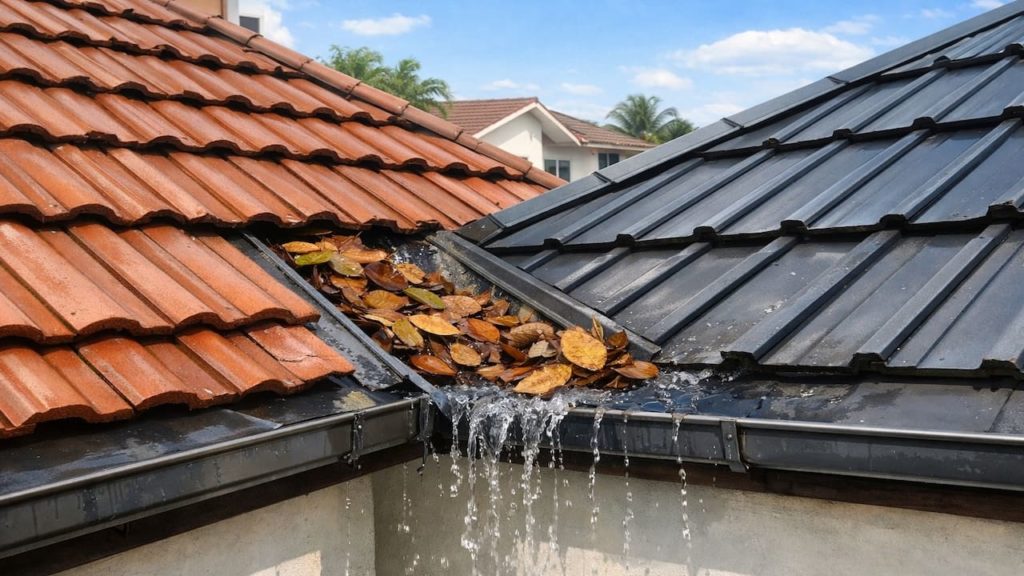
In Malaysia rain, valleys handle runoff from two roof planes, so leaves and grit can build up fast—then water pools and creeps under laps. Slow seep.
- Lift valley cover and remove wet leaf mats
- Flush valley channel and watch standing water
- Check tile edges beside valley for displacement
- Inspect valley metal for rust pinhole spots
- Check underlay near valley for damp streaks
Some people assume the tile above the stain is cracked, because that feels logical. In valleys, water often enters at a seam and travels sideways, so cracks are not required. Confirm pooling first, then inspect seams. Clear.
2. Leaves trap water and force overflow
Leaf buildup forces overflow into joints and ceiling voids.
Wet leaves compress into a paste in Malaysia humidity—then the valley becomes a dam and water searches for the next exit, often under tile edges and flashing corners. Predictable.
- Scoop leaf paste from valley low point
- Clear sand grit from valley seam overlap
- Check eave splash marks under valley outlet
- Inspect gutter mouth below valley for clogging
- Look for damp soffit return near valley end
Some say “Leaves are normal and harmless,” because everyone has them. In wet season storms, that leaf dam turns a safe valley into a spillway. Remove debris, then recheck for seep lines. Practical.
3. Why + Valley seams fail under storm pressure
Storm pressure drives water under valley laps and seams.
During Malaysian squalls, wind pushes rain sideways while runoff volume spikes—valley laps see both forces at once, and tiny seal failures become active paths. Harsh test.
- Check valley lap edge for lifted seal line
- Inspect fasteners for loose washers and rust
- Look for sealant shrink along seam junction
- Check ridge to valley transition for open gap
- Inspect wall junction flashing near valley head
You might think “It only leaks in storms so it is rare,” and that feels comforting. In Malaysia, storms are the standard condition, so a small seam weakness will repeat. Fix the seam detail, not the paint stain. Certain.
4. How + Clear the valley and stop overflow paths
Clear the valley then seal one confirmed entry point.
Random patching fails in Malaysia because moisture gets trapped—then mold grows and the drip appears elsewhere, even if the valley looks clean. Controlled work wins.
- Photograph stain and record rain start end times
- Dry ceiling area and wait for fresh wet
- Hose test valley head then valley mid section
- Check attic for shiny trails near valley line
- Apply roof grade compound on cleaned dry seam
Some people want to coat the whole valley immediately, because it feels like a strong solution. If debris remains or the seam is still moving, coating becomes a temporary skin and fails. Clean first, reproduce the leak, then seal once. Done.
5. FAQs
Q1. Why do valley leaks show up far from the valley line?
Water can enter at the valley seam and travel along underlay, rafters, or wiring trays before dropping at a low point. Malaysia humidity keeps that travel active longer.
Q2. How often should I clear valley debris in wet season?
If trees are nearby, check after each big storm and do a quick clean weekly during peak rainy months. A short routine prevents leaf paste dams.
Q3. Can gutter overflow cause a valley leak symptom?
Yes, if the gutter mouth below the valley is clogged, water backs up and splashes under tile edges near the valley end. Check both valley and gutter flow.
Q4. What if the wet stain is near a light or ceiling fan?
Cut power to that circuit and avoid the area until it is checked. Water near wiring is dangerous in humid Malaysia homes and can escalate quickly.
Q5. Should I use silicone or roof compound on valley seams?
Use roof grade compounds designed for roofing movement and UV exposure, and apply only on clean dry surfaces. Silicone on wet dusty seams often peels fast.
Pro’s Tough Talk

I’ve been on site for 20+ years and handled hundreds of roof and ceiling jobs, and valley leaks are the wet season classic. You swear the roof is fine, then one storm proves otherwise.
In Malaysia, it is usually 3 causes. Leaves turn into sticky paste and dam the channel. Valley seams loosen from heat and rain cycles. Fasteners and washers age, then tiny gaps turn into hidden paths.
Two relatable moments, because this always happens. You clear the gutter and feel proud, then the valley is still packed like a sandwich. You put a bucket under the stain, and it drips 20 cm away anyway.
Control the water path and the leak stops feeling random with 3 steps. Clear the valley fully. Hose test one small zone at a time. Check the ceiling void for shiny trails and wet nails.
Do not blame yourself, and do not call every contractor a villain, but the structure is cold: water travels sideways and your money runs straight out if you guess. The “just coat everything” hero gets my jab. Enjoy your midnight bucket hobby if you ignore it.
Summary
Valley leaks in Malaysia usually start from trapped debris, overflow, and storm pressure that drives water under seams. The stain is the symptom, not the source. Fact.
Clear debris, restore flow, then reproduce the leak with one zone hose testing to confirm the exact seam or junction. If it keeps returning, focus on valley laps and transitions.
Clear the valley today then test one zone tomorrow and continue with our guides on gutter overflow, roof flashing cracks, and ceiling mold control for wet season homes.