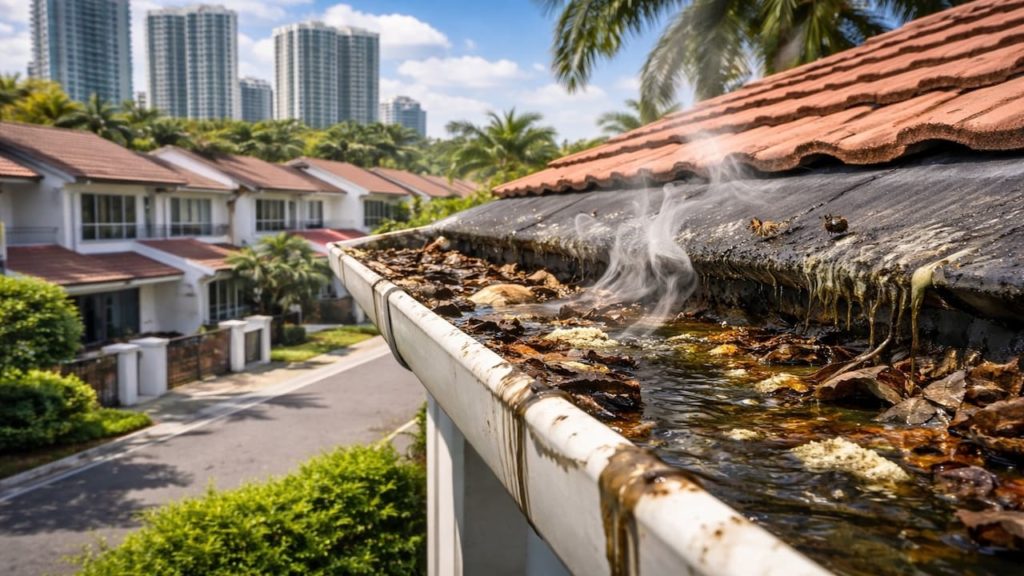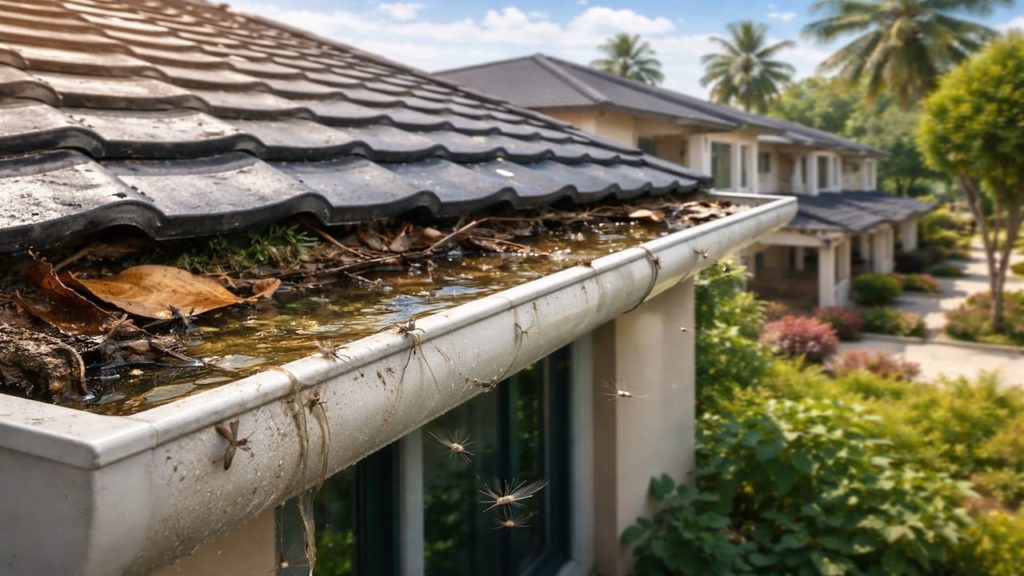
You see mosquitoes hovering near the roof edge, and bites start even though your room is closed and the aircond is on.
In Malaysia, warm humidity and wet-season bursts create tiny water pockets, and gutters on condos and terrace houses become quiet nurseries.
In this guide, you’ll learn how to remove breeding water fast by checking roofline spots that trap water and feed mosquitoes.

Hi, I’m Ken. I write practical home guides for Malaysia—no fluff, just what works.
I hold a formal building design qualification and have spent about 20 years on job sites across hundreds of projects. My goal is simple: help you avoid costly mistakes with clear, safe steps—a quick way to decide what to do next.
1. Gutter attracts mosquitoes: 5 checks
Any standing water in a gutter can breed mosquitoes so your job is to find where water stays after rain and clear it.
Malaysia heat speeds up breeding, and Aedes mosquitoes use small puddles—so a hidden cup of water can be enough. Real risk.
- Check the lowest sag point where water remains 12 to 24 hours after rain, not just right after the storm.
- Inspect the downpipe mouth for a leaf plug that creates a backwater pool inside the gutter.
- Look for joint dams where debris packs at connectors and holds water like a mini reservoir.
- Check shaded runs under overhangs where algae film forms and keeps moisture from drying out.
- Inspect roof valley drop zones where heavy flow dumps grit and seeds that build a muddy bed.
Some people say “mosquitoes come from outside anyway,” and that is partly true. But roofline breeding adds daily pressure, so removing gutter water lowers bites quickly.
2. Remove breeding water around roofline
Drainage fixes beat sprays because mosquitoes return when water remains around soffits, porch edges, and shared corridors.
On many Malaysia condos, the roofline sits close to windows and lights, and mosquitoes drift indoors when doors open—easy entry. Annoying.
- During a dry window, scoop wet sludge into a bag so it cannot wash back in with the next downpour.
- Flush the gutter toward the outlet and confirm strong discharge at the downpipe exit on the ground.
- Clear the downpipe from the bottom using gentle hose pulses so you avoid slippery climbing.
- Fix sagging by tightening or adding brackets so water cannot pond near the roof edge.
- Rinse algae zones and remove trapped seeds, then let sunlight dry the surface where possible.
You might think repellent is enough, but repellent is a bandage. If you remove water sources, the night buzzing drops and the porch stays safer.
3. Why mosquitoes breed in gutters
Mosquitoes choose gutters because they are protected and wet especially when debris creates shallow pools that predators cannot reach.
Malaysia’s year-round warmth shortens the breeding cycle—so a few days of trapped water can become many adults. Fast multiplication.
- Leaves and roof grit form a sponge layer that holds water even after the gutter looks dry from above.
- Slow drains keep water calm, and calm water is safer for eggs and larvae than rushing flow.
- Shaded sections stay wetter, so evaporation stays slow in humid air after rain.
- Blocked outlets raise the waterline and create hidden puddles behind debris dams and joints.
- End caps and corners trap water in small pockets you rarely check during routine cleaning.
Some people blame only nearby drains and gardens, and those matter too. Still, a roofline gutter is a high, quiet container, so it breeds without you noticing.
4. How to stop gutter mosquitoes fast
Eliminate standing water first then keep flow strong so the gutter cannot hold eggs after every heavy Malaysian rain.
Work in short cycles, because wet season brings many small storms instead of one perfect weekend. Simple routine—effective.
- After a storm, do a 2 minute visual check for any section that looks full or dark with algae bands.
- Clear the outlet area, then run water and watch for steady downpipe discharge for 30 to 60 seconds.
- Address sag points with extra support so water drains downhill instead of pooling near bedrooms or porch entries.
- Use an outlet screen you can remove and rinse, and clean it often during rainy weeks.
- If access is unsafe, schedule a pro clean during a dry stretch rather than climbing in damp heat.
People worry they must do everything perfectly, but one stuck puddle is enough. Remove the puddle, confirm flow, and the breeding cycle breaks.
5. FAQs
Q1. Can mosquitoes really breed in a gutter with moving water?
They need calm pockets, not a full rushing stream. If your gutter has sags or debris dams, pockets form even during rain.
Q2. How long does it take for gutter water to become a breeding site?
In warm Malaysian weather, it can be quick when water sits for days. Treat any water that remains after 24 hours as a problem.
Q3. Should I pour bleach or chemicals into the gutter?
It may reduce larvae short term but it does not remove sludge, and runoff can be messy. Fix the standing water source and you remove the breeding site at its root.
Q4. I live in a condo, can I do anything without roof access?
Yes—start with downpipe outlet checks and request building maintenance to clean gutters if flow is weak. Lights can attract adults at night.
Q5. How often should I check during rainy season?
After big storms and at least every 4 to 6 weeks in wet months. Small checks prevent hidden pools from coming back. Worth it.
Pro’s Tough Talk

I’ve been on site for 20+ years and handled hundreds of roofs, gutters, and drains in tropical heat and wet-season rain. A gutter with sludge is a tiny aquarium that nobody cleans, but mosquitoes love it.
Three causes. One, sagging makes a pond. Two, the downpipe is half-blocked so water sits. Three, leaf mush turns into a sponge that never dries. Steps: clear the outlet, flush from the bottom, then add support so the run drains clean.
Don’t blame yourself, and don’t call every worker a villain, but some “cleaning” is just pushing gunk to the next corner. You slap on repellent, still hear buzzing at 1 a.m., then spot larvae and go “seriously.” Classic. Dry gutters mean fewer bites so stop feeding them and sleep like a human.
Summary
Mosquitoes breed in gutters when water stands in sags, joints, and blocked outlets, especially in Malaysia’s warm humid rainy cycle. Preventable.
Find the section that stays wet after 24 hours, remove sludge, and confirm strong downpipe discharge from the ground. Keep it draining.
Do a quick post-storm roofline check this week—then fix the low spot and retest after the next rain. Remove the puddle and you break the cycle and next read gutter smells from stagnant water.