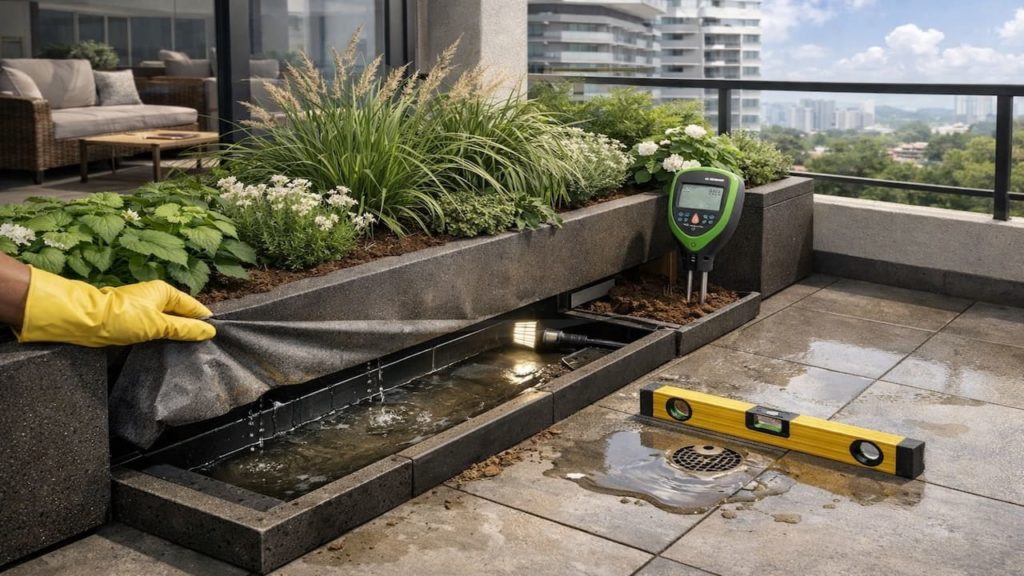
You search because gutter guards still let water spill, or you see leaves and sandy grit building up near the roofline after storms.
In Malaysia, monsoon rain hits hard, then hot humid days bake debris into sludge, so condos and terrace houses need guards that suit real conditions.
In this guide, you'll learn how to choose and check gutter guards so they block leaves and sand without killing drainage.

Hi, I’m Ken. I write practical home guides for Malaysia—no fluff, just what works.
I hold a formal building design qualification and have spent about 20 years on job sites across hundreds of projects. My goal is simple: help you avoid costly mistakes with clear, safe steps—a quick way to decide what to do next.
1. Gutter guard helps: 5 checks
A good gutter guard must keep flow fast while stopping the junk that turns Malaysian rain into overflow.
Do these checks after a storm when evidence is fresh—guards can look fine from the ground but hide traps at corners. Reality.
- Water runs to the downpipe without pooling behind the guard during a short hose test.
- Leaves sit on top and dry out, not slip under and form a wet mat inside the gutter.
- Fine sand and roof grit do not blanket openings and slow drainage within 1 to 2 weeks.
- The guard stays tight at joints and corners, with no lifted lip that sends water behind the gutter.
- You can remove or open it for cleaning without special tools or risky roof walking.
Some guards look premium and still fail in storms. If flow slows or pooling appears, the guard is not helping. Keep drainage first and the guard becomes useful.
2. What works for leaves and sand debris
Leaf control and sand control need different designs so pick for the main enemy on your roof edge.
Malaysia has two problems at once—big wet leaves during rainy weeks and fine grit from roofs and nearby work in dry spells. Trade off.
- For big leaves, a raised mesh that lets leaves dry and blow away works better than tiny holes.
- For fine sand, micro mesh can block grit, but only if the surface is smooth and easy to rinse.
- If you get both, a solid cover can shed leaves, yet it still needs an open channel for grit.
- Snap in guards are easy to fit, but they may lift in wind driven rain on long condo runs.
- Fixed guards reduce lifting, but you must plan access for wet season rinsing.
People want set and forget, but tropical gutters punish that idea. Choose the style you can maintain and the style that matches your debris. Simple.
3. Why gutter guards fail in Malaysia
Guards fail when they create hidden clogging and the gutter still fills during peak storm minutes.
Heat grows algae film, humidity keeps debris wet, and downpours slam water into the guard surface—so tiny blockages turn into floods. Quiet failure.
- Micro mesh traps fine grit and becomes a flat mud layer that blocks flow.
- Leaves shred into fibers, slide under loose edges, and build a sponge at the outlet.
- Bad slope leaves water sitting longer, which speeds algae and smell in humid air.
- Joints and corners lift first, and water shoots behind the gutter and stains walls.
- Cleaning is skipped because access feels annoying, and the guard becomes a lid on a mess.
It is tempting to blame the rain, but the issue is outflow loss. If the guard makes inspection harder, it will fail. A guard must support drainage, not hide problems.
4. How to choose and maintain a guard that works
Choose for easy cleaning and strong outflow so storms drain fast and debris does not become mosquito water.
Think Malaysia timing: heavy rain arrives suddenly, and humidity keeps gutters wet—so you need a guard you can rinse safely on a dry break. A routine.
- Start with a hose test to confirm where water pools and where the downpipe struggles.
- If you face mostly leaves, prioritize a leaf shedding cover or larger mesh that avoids wet mats.
- If fine sand is the main issue, pick micro mesh only if you can rinse it often.
- Secure corners and joints, then add brackets where sagging creates ponding behind the guard.
- During wet months, do a quick check after major storms and a rinse every 4 to 6 weeks.
Some people install guards and stop thinking forever. That is the trap. With the right design and a small routine, guards cut cleanup and reduce overflow. Done.
5. FAQs
Q1. Do gutter guards reduce mosquitoes in Malaysia?
They help only if they prevent standing water. If the guard causes pooling, mosquitoes still breed and bites continue. No magic.
Q2. Are micro mesh guards always best?
No—they can clog with grit and algae film. They work when you can rinse them often and keep the surface open.
Q3. How do I know my guard is reducing flow?
Do a short hose test and watch for pooling behind the guard. Fast discharge at the downpipe is the proof and slow flow means the guard is acting like a plug.
Q4. Can guards cause water stains on walls?
Yes, if corners lift or water jumps behind the gutter. Check edges after storms and secure any loose section.
Q5. What is the simplest maintenance plan?
In wet season, check after big storms and rinse on a dry day once a month. If trees are close, shorten the interval.
Pro’s Tough Talk

I've been on site for 20+ years and handled hundreds of gutters in tropical heat and wet season rain. A gutter guard is not armor. It is a filter, and filters clog when you ignore them.
Three causes: mesh turns into a mud cookie, loose edges let leaves sneak under, and sagging holds water like a bathtub. Steps: test discharge, choose for your debris, then lock corners and add support so water drains.
You are not dumb and most contractors are not monsters, but some installs are vibes and prayers. You hear overflow at night, then you find green slime in the morning, and you go "seriously." Pick a guard you will actually clean or keep paying for the same mess like it is a subscription.
Summary
Gutter guards help when they keep flow fast and stop leaves and fine grit from building dams that cause pooling and overflow. Malaysia makes this urgent.
Match the guard style to your debris—secure corners and confirm strong downpipe discharge after storms. Maintain lightly during wet months so the surface stays open.
Do one hose test this week, fix any pooling, and choose a cleanable guard if you replace it. Good guards save time when flow stays strong and next read about downpipe blockage checks.