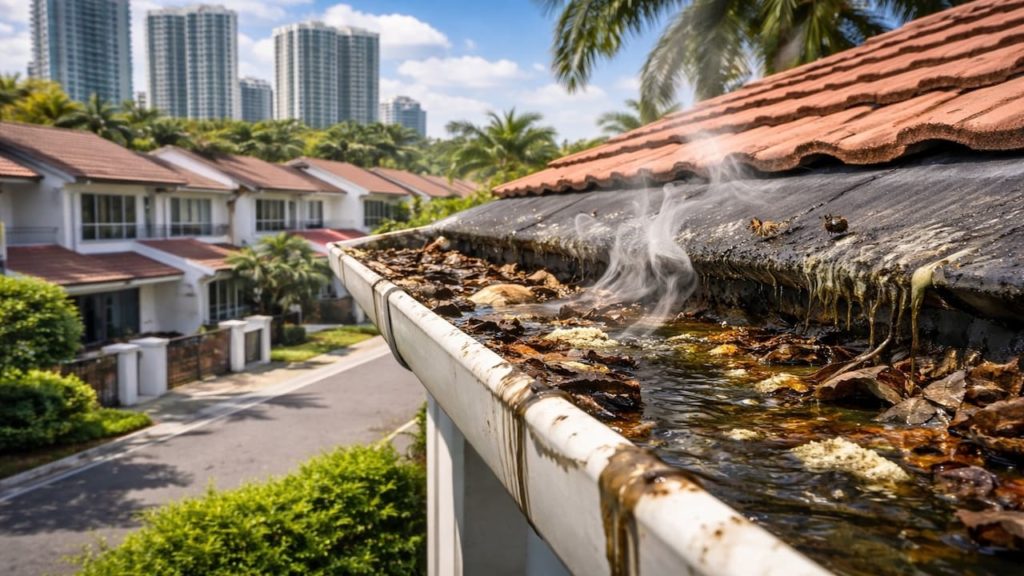
You get a roof-edge waterfall at one exact spot, while the rest of the gutter run looks normal, and it happens again in the next heavy rain.
In Malaysia, sudden downpours fill gutters fast, and humid heat turns small debris pockets into sticky dams on condos and terrace houses. One weak point.
In this guide, you’ll learn how to pinpoint the blockage location when overflow happens in only one spot, so you stop repeat splashes and wall stains.

Hi, I’m Ken. I write practical home guides for Malaysia—no fluff, just what works.
I hold a formal building design qualification and have spent about 20 years on job sites across hundreds of projects. My goal is simple: help you avoid costly mistakes with clear, safe steps—a quick way to decide what to do next.
1. Gutter overflow only one spot: 5 causes
One-spot overflow usually means a local restriction that raises water level right there until it spills over the lip or back edge.
Malaysia storms surge quickly, so the first weak link fails loud. Follow the overflow point, then look just upstream where water is stacking. That is the clue.
- A debris dam at a joint connector that traps leaves and grit like a mini wall.
- A sagging low pocket that holds water and overflows before it can travel to the outlet.
- A downpipe mouth partly blocked, causing backup that spills at the nearest low seam.
- A bent or crushed gutter section from impact that narrows the channel locally.
- A roof valley dumping concentrated flow onto one short section and overwhelming it.
You might assume the whole gutter is clogged, but one-spot overflow is usually one local problem. Fix that zone and the run behaves again.
2. Find the blockage location fast
The fastest method is a simple “upstream test” so you do not guess and clean the wrong section.
In Malaysia, you often only get short dry breaks between storms, so speed matters. Do safe ground-level observation first, then check the nearest sections during a dry window. Practical approach.
- During rain, watch where overflow starts, then note if water is flowing strongly downstream of that point.
- Look at the gutter just upstream of the spill; if it looks fuller, that is where water is stacking.
- Check the downpipe outlet discharge; weak discharge with overflow nearby suggests a pipe restriction.
- After rain, do a hose test: start pouring water upstream and see where it slows or backs up.
- Mark the exact spot with tape or chalk so you target that section for cleaning and support fixes.
Some people clean the entire gutter and still get overflow because the real dam sits at one joint. Locate the dam first, then remove it and retest. Done.
3. Why one-spot overflow is common in Malaysia
Tropical debris turns into a sticky plug and it forms at predictable trap points like joints, corners, and outlet throats.
Heat breaks leaves into fibers, humidity keeps them wet, and heavy rain compacts them into sludge. That sludge builds faster in shade and in low spots. Condos also have long runs that concentrate debris at certain connectors. Pattern.
- Algae film glues fine sand onto seams and creates a gritty ridge that catches leaf bits.
- Short sag areas become settling basins where debris sinks and forms a dam.
- Outlet screens clog and create a backup zone that overflows at the nearest weak seam.
- Roof valleys dump grit and seeds in one drop zone, creating a local debris mound.
- Expansion and contraction loosen clips, and slight misalignment creates a lip that catches debris.
This is why overflow can look “random,” but it is not. The trap point stays the same and keeps rebuilding the dam until you fix the trap.
4. How to fix the one spot and stop repeat overflow
Clear the restriction and remove the trap condition so debris cannot rebuild in the same place after every Malaysian storm.
Work only in a dry window with stable footing—wet tiles and ladders are risky. Start from the outlet area and work upstream so you do not push debris into the pipe. Method matters.
- Scoop out sludge at the marked spill zone and bag it, then rinse lightly to reveal the gutter floor.
- Clear the downpipe mouth and confirm strong discharge at the outlet for 30 to 60 seconds.
- If the section sags, tighten brackets and add one support at the low point so water cannot pond.
- If a joint has a debris ridge, reseat the connector and seal only after the seam is clean and dry.
- After the next storm, recheck the same spot and confirm no water stacks up there anymore.
If overflow still happens at the same point after cleaning and support, the gutter may be undersized for that roof drop zone. Then you need capacity changes, not more cleaning. Upgrade time.
5. FAQs
Q1. Does one-spot overflow always mean a clog?
Often yes, but it can also be sagging, a crushed section, or a roof valley overload. Use discharge checks and hose testing to confirm.
Q2. What is the easiest sign that the downpipe is involved?
Weak outlet discharge while the gutter near the pipe stays full is a strong clue. Backup usually spills at the nearest low seam.
Q3. Can a gutter guard cause one-spot overflow?
Yes, if the guard clogs locally or lifts at one corner and sends water behind the gutter. Pooling behind the guard is the giveaway during a hose test.
Q4. Is it safe to fix this during rainy season?
Only during a dry break and with safe access. If the area is high or slippery, call a pro or building maintenance for condos.
Q5. How do I stop it from coming back?
Remove the debris dam and fix the trap condition: add support at sag points, keep the outlet clear, and check after major storms. Small routine works.
Pro’s Tough Talk

I’ve been on site for 20+ years and handled hundreds of gutters in tropical heat and wet-season rain. One-spot overflow is the gutter version of a traffic jam at one exit. The road is fine, the exit is choking.
Three causes: a joint ridge that catches junk, a sag pocket that holds a pond, or a downpipe mouth half blocked so water stacks up. Steps: mark the spill point, clear sludge starting at the outlet, then brace the low spot or reseat the joint so the trap disappears.
Don’t blame yourself, and don’t call every contractor a villain, but some people “clean” by pushing the mess to the next corner. You know the two classics: you see the waterfall at the same spot, you put a bucket under it, and you tell yourself it is solved. Genius move. Find the dam and kill it or keep watching the same spot overflow like it is your nightly show.
Summary
One-spot overflow usually means a local restriction like a joint debris dam, sag pond, crushed section, or downpipe backup. Malaysia rain makes the weak link obvious.
Find the blockage fast by marking the overflow point, checking downstream discharge, and doing a simple hose test to see where flow slows. Then fix the trap condition so it cannot rebuild.
After the next storm, mark the first spill spot, clear that zone and the outlet, then retest flow for a full minute. One fix beats endless guessing and next read about downpipe blockage checks and storm overflow reasons.